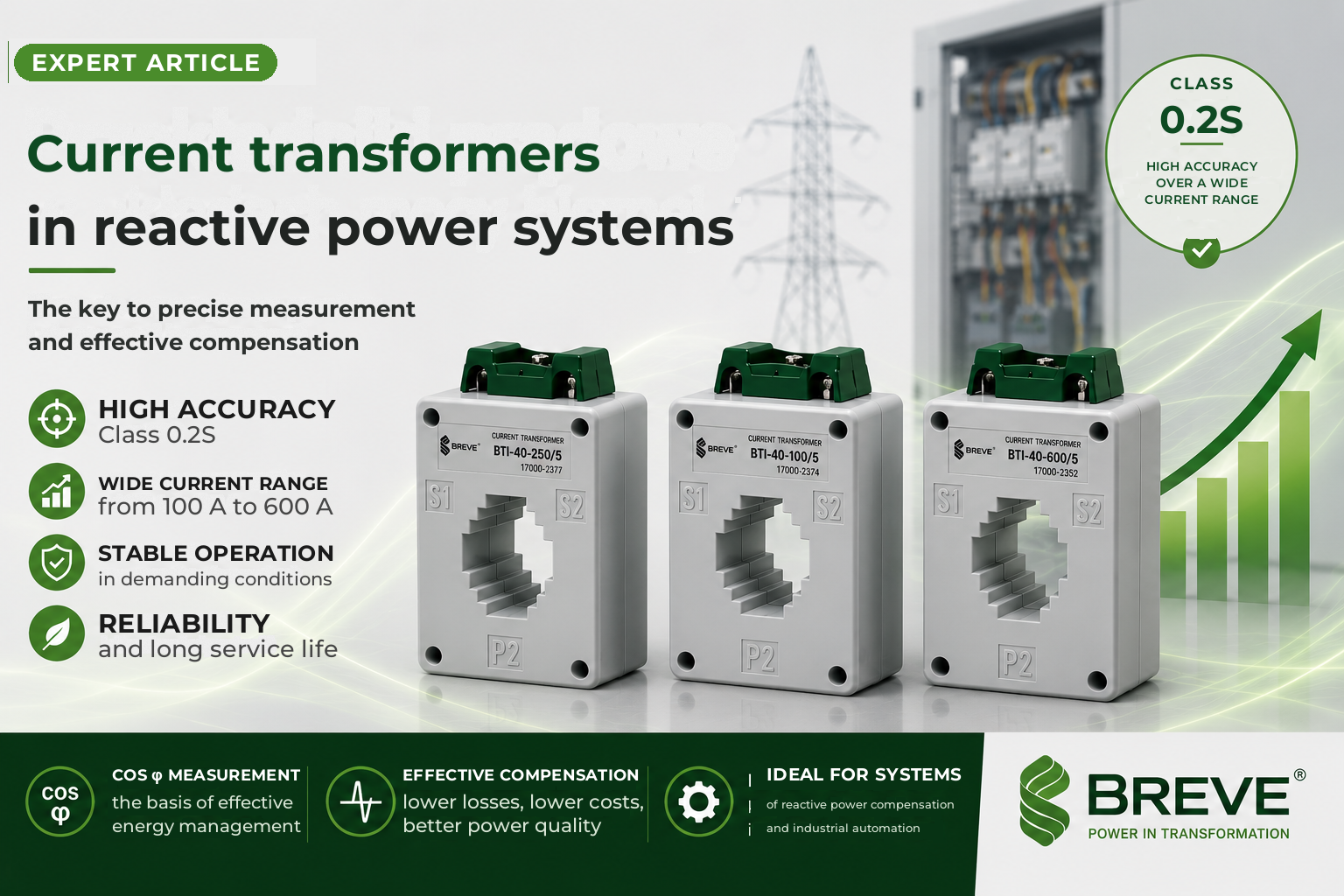
Modern production facilities increasingly face high electricity costs. Beyond active energy consumption itself, charges for reactive energy are also gaining importance, and in many companies they represent a significant item on energy bills.
A properly designed reactive power compensation system can significantly reduce these costs. However, even the best power factor controller will not operate correctly if it receives inaccurate information about the current network load. The key element of any compensation system is therefore the current transformer, responsible for precise current measurement.
Why does current transformer accuracy matter so much?
The power factor controller decides whether to switch successive capacitor bank steps in or out based on measurements of:
- current,
- voltage,
- power factor (cos φ).
If the current measurement carries a large error, the controller receives imprecise data and may:
- switch in too many compensation steps,
- switch them out with a delay,
- cause overcompensation of the installation,
- increase the number of contactor switching operations,
- shorten the service life of the capacitor bank.
In practice, this means higher operating costs and poorer performance of the entire system.
Load characteristics in production facilities
In most industrial plants, the installation load changes very dynamically. A typical production day looks as follows:
- production lines are started up in the morning,
- during the day some machines operate cyclically,
- the number of running drives changes,
- compressors, furnaces, fans and pumps are switched on,
- during production breaks the power draw falls sharply.
The current in the main supply often varies from a few percent to 100% of the current transformer’s rated value. It is precisely under such conditions that transformers with a very high accuracy class demonstrate their advantage.
What sets accuracy class 0.2S apart?
In conventional class 0.5 or 1 transformers, measurement accuracy drops significantly at low loads. Class 0.2S transformers, by contrast, have been designed specifically to measure very accurately even at low currents.
The letter “S” (Special) denotes an extended accuracy range, thanks to which the transformer maintains high precision from a very small percentage of the rated current upward. This is extremely important precisely in reactive power compensation systems, where the controller must also respond correctly when the installation load is low.
Benefits of using class 0.2S current transformers
High measurement accuracy translates directly into the operation of the entire compensation system. The most important advantages are:
- much more accurate determination of the power factor,
- more stable operation of the power factor controller,
- reduced overcompensation,
- fewer switching operations of the capacitor bank steps,
- longer service life of contactors and capacitors,
- more effective compensation under highly variable loads,
- the ability to keep the power factor close to the set value around the clock.
As a result, the company reduces its reactive energy charges and lowers the servicing costs of the compensation system.
BREVE BTI current transformers
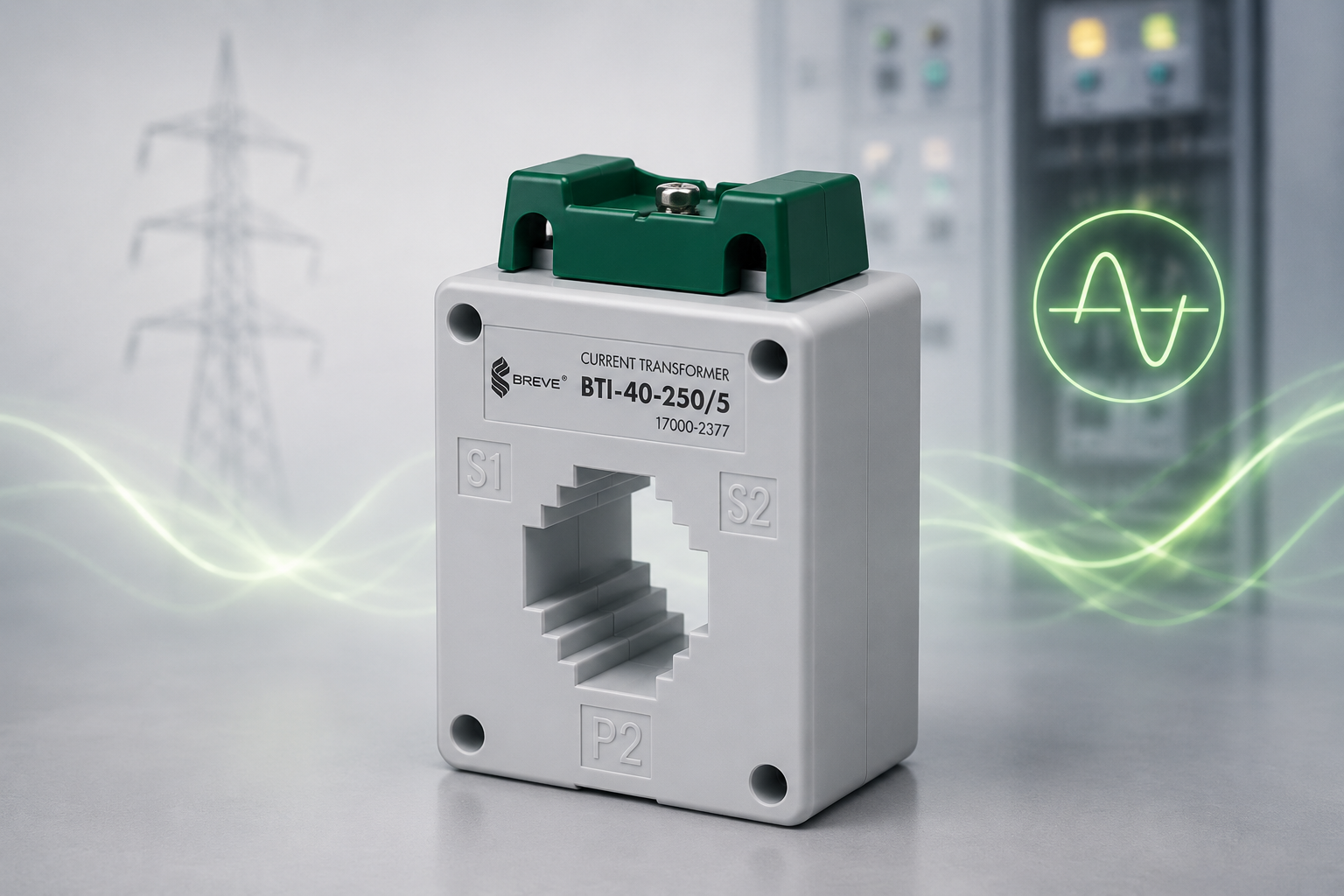
The BREVE offering includes the BTI series, designed for measuring alternating current in low voltage installations up to 660 V AC and at frequencies of 50–60 Hz. The transformers enable accurate measurement of current and electrical energy in metering systems and meet the requirements of standards EN 61869-1:2009 and EN 61869-2:2013. Versions are available with a secondary current of 1 A or 5 A, degree of protection IP20 and insulation class B.
The series comprises several mechanical sizes (BTI-20, BTI-30, BTI-40, and in the future BTI-50 and BTI-60), making it possible to select the right transformer for the busbar cross-section and the required primary currents – from 100 A to 600 A (under development up to 2000 A), depending on the model.
Thanks to this broad range, BTI transformers can be used both in small industrial switchgear and in large power installations.
When is class 0.2S the right choice?
Class 0.2S transformers are particularly recommended in installations where:
- the load varies over a wide range,
- numerous inverters (VFDs) are in operation,
- production is multi-shift,
- production lines are frequently started and stopped,
- reducing reactive energy costs is important,
- modern power factor controllers with a large number of compensation steps are used.
The greater the dynamics of the load changes, the greater the advantage offered by a high accuracy class transformer.
A good current transformer is an investment, not a cost
In practice, the price difference between a standard transformer and a class 0.2S version is small compared with the operating costs of the entire compensation system.
Much more accurate measurement allows the controller to make the right decisions throughout many years of the installation’s operation. The results are:
- lower energy bills,
- less wear on the capacitor bank,
- fewer contactor switching operations,
- greater stability of the power factor,
- higher reliability of the entire system.
Summary
Rising energy prices make effective reactive power compensation one of the simplest ways to reduce a company’s operating costs.
However, the quality of the entire system’s performance is determined not only by the controller or the capacitor bank, but also by the accuracy of the current measurement. Using class 0.2S current transformers makes it possible to track load changes precisely even at low currents, so that the compensation system operates more stably and efficiently around the clock.
Thanks to their broad range of models, high build quality and compliance with applicable standards, BREVE BTI current transformers provide a reliable solution for modern industrial installations where measurement precision and maximum energy efficiency matter.