Electromagnetic compatibility (EMC) is the ability of an electrical device to operate correctly within a specified electromagnetic environment without introducing unacceptable electromagnetic disturbances into that environment. In the case of direct current (DC) power supplies, most of which are sophisticated switching-mode devices, EMC performance is a critical factor affecting the stability of the entire electronic system. A low-cost power supply lacking adequate filtering can disrupt industrial automation networks, interfere with precision sensor readings, and, in extreme cases, damage sensitive microcontrollers.
The Root of the Problem: How a Switching Power Supply Generates Noise
Modern switching-mode power supplies (SMPS) have largely replaced traditional transformer-based power supplies. Their primary advantages are high energy efficiency and compact size. However, their operating principle relies on switching power transistors (MOSFETs or IGBTs) at very high frequencies, typically ranging from several tens of kilohertz to several megahertz.
This switching process generates rapid voltage and current transitions, which are the primary source of electromagnetic interference (EMI). These disturbances propagate in two ways:
- Conducted emissions: These travel as high-frequency currents along the AC input cables and DC output wiring. They are divided into differential-mode (DM) noise, flowing between the supply conductors, and common-mode (CM) noise, which returns through parasitic capacitances to ground.
- Radiated emissions: These are emitted directly into the surrounding space as radio-frequency waves, with the power supply cables effectively acting as transmitting antennas.
Key EMC Standards for DC Power Supplies
Compliance with EMC standards is the only formal assurance that a power supply has been tested for both electromagnetic emissions and immunity to interference. Within the European Union, the legal framework is established by the EMC Directive 2014/30/EU. When evaluating DC power supply specifications, references should be made to the following harmonized standards.
PN-EN IEC 61204-3
This is the primary product-specific standard for low-voltage DC switching power supplies. It precisely defines both emission limits and immunity requirements according to the intended operating environment, such as residential or industrial applications.
PN-EN 55032 (CISPR 32)
This important standard specifies limits for radiated and conducted emissions from multimedia and information technology equipment. It classifies equipment into two fundamental categories:
- Class B (more stringent): Intended for residential, office, and commercial environments, requiring very low emission levels.
- Class A (less stringent): Permitted only in industrial environments, where background electromagnetic noise levels are naturally higher.
PN-EN IEC 61000-3-2
This standard specifies limits for harmonic current emissions injected into the public AC power grid. Equipment that does not comply with this standard distorts the mains voltage waveform, leading to overheating of transformers and neutral conductors within building electrical installations.
EN IEC 61000-6 Series
These general EMC standards apply when the power supply is intended for specific operating environments:
- PN-EN IEC 61000-6-2: Immunity requirements for industrial environments, including resistance to electrostatic discharge (ESD), electrical fast transients (EFT/Burst), and surge voltages.
- PN-EN IEC 61000-6-4: Emission requirements for industrial environments.
The Hidden Risks of Low-Cost DC Power Supplies
Cheap, unbranded DC power supplies are attractive because of their low purchase price. However, manufacturing cost reductions are typically achieved by compromising the components responsible for safety, EMI filtering, and operational stability.
- Reduced or Missing EMI Filters
To comply with EMC emission standards, a power supply must include a multi-stage EMI input filter consisting of common-mode chokes and dedicated suppression capacitors, including Class X capacitors (connected between line and neutral) and Class Y capacitors (connected between live conductors and protective earth).
In the cheapest designs, common-mode chokes are often replaced with simple wire links, while PCB footprints for suppression capacitors remain unpopulated. Such power supplies become significant sources of electromagnetic noise, interfering with radio receivers, Wi-Fi routers, and industrial communication networks such as RS-485, Modbus, and CAN.
- Absence of Soft-Start (Inrush Current Limiting)
When a power supply is connected to the AC mains, its primary electrolytic capacitors draw a very high charging current. Professional designs incorporate soft-start circuits, typically using NTC thermistors and relay bypass arrangements, to limit this inrush current. Low-cost power supplies often omit these circuits, resulting in substantial current spikes that can randomly trip circuit breakers and accelerate wear on power switches and relay contacts.
- Performance Degradation Due to Temperature
Budget power supplies frequently use components with limited operating lifetimes and lower temperature ratings, such as 85°C electrolytic capacitors instead of high-quality 105°C components. As the power supply ages and operates at elevated temperatures, filter capacitance decreases significantly, leading to increased output voltage ripple and substantially higher EMC emissions.
- Severely Reduced Electrical Isolation Distances
Compliance with electrical safety standards, such as EN 62368-1, requires adequate creepage and clearance distances on the printed circuit board between the high-voltage AC input section and the low-voltage DC output section. To reduce manufacturing costs and PCB size, inexpensive power supplies often minimize these distances to only fractions of a millimeter. This creates a genuine risk of electrical arcing, insulation breakdown, and the appearance of hazardous 230 V mains voltage on the DC output, potentially causing electric shock or fire.
What to Look for When Purchasing a DC Power Supply
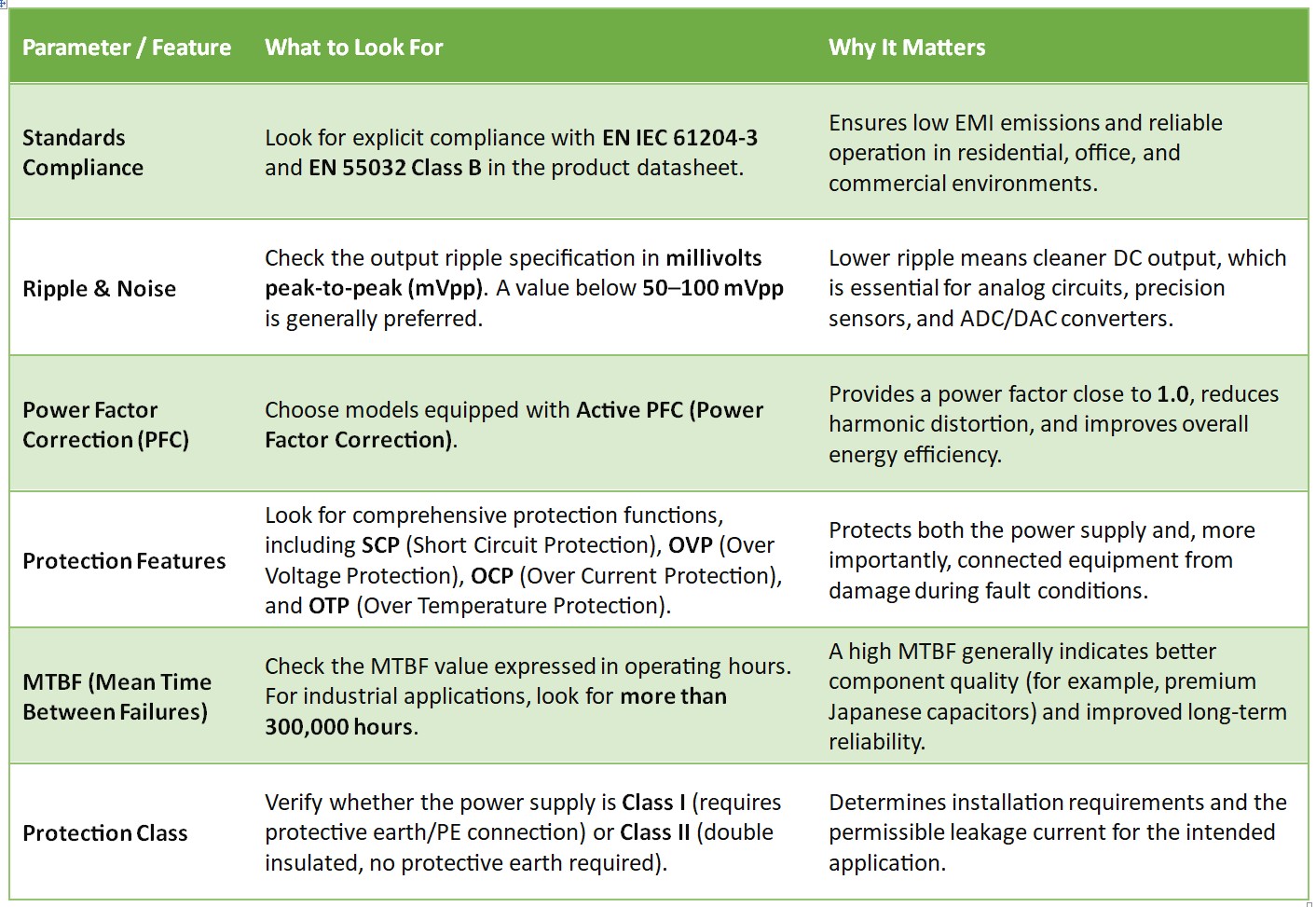
When selecting a professional DC power supply, purchasing decisions should not be based solely on output power and price. The technical specifications should be carefully evaluated to verify compliance with EMC requirements, safety certifications, filtering design, and overall product quality.
Saving money on a power supply is often a false economy. Choosing a proven product from a reputable manufacturer protects the entire system from unexplained software crashes, communication errors, electromagnetic interference, and physical component failures. A properly engineered EMC filtering stage is an investment in the long-term reliability, stability, and safe operation of the entire application.