Switching power supplies, as the name suggests, are electronic devices that process energy using high-frequency pulses. They can therefore—and inevitably do—generate electromagnetic disturbances. These disturbances can be harmful to other devices connected to the same local power network (in which case they are referred to as conducted disturbances) or may negatively affect the surrounding environment through electromagnetic waves (in which case they are referred to as radiated disturbances).
Today, the number of devices that generate or are susceptible to electromagnetic disturbances is so large that this issue has had to be regulated. Otherwise, we would not be able to use, for example, mobile communications or many of the other benefits of modern technology. These regulations are set out in standards governing so-called electromagnetic compatibility, commonly abbreviated as EMC (Electromagnetic Compatibility). In Poland, compliance with these standards is overseen by the Office of Electronic Communications (UKE), whose main responsibilities include monitoring compliance with electromagnetic compatibility requirements. As part of its duties, UKE employs specialized teams and laboratories, as well as inspectors authorized to conduct inspections, issue recommendations, and impose substantial penalties for non-compliance with EMC standards.
The Market – Practices – Jargon.
Today, numerous suppliers of switching power supply brands operate on the Polish and European markets. They rely either on in-house or outsourced production and pursue a variety of commercial strategies, including rebranding devices manufactured by other companies. Regardless of the market strategy they adopt, they are all subject to the same EMC regulations and are required to comply with them without exception. Competition is extremely strong, which benefits users by keeping final prices attractive.
However, the market also contains power supplies that do not comply with EMC standards. These devices are cheaper because they have been stripped of a number of components responsible for filtering and suppressing disturbances. In such cases, UKE inspectors step in, acting both on the basis of their own inspections and in response to reports from customers or competing companies.
Sales targets can also be pursued through the use of industry jargon. Two examples are:
- Power supply for industrial applications.
- Power supply for domestic applications.
These two seemingly harmless terms are generally interpreted by users—and even by qualified electricians—in the opposite way to what the actual permissible electromagnetic disturbance limits would suggest. For most people, the word “industrial” is synonymous with high durability, high reliability, and a generally higher class of product. By contrast, when compared with an “industrial” product, the word “domestic” tends to suggest something of lower quality or status.
Why do we see things this way? Probably because industry is associated with significant financial responsibility. We realize that a production shutdown caused by a power supply failure can be extremely costly. Therefore, it seems logical that industrial power supplies must be better. And this is where an interesting surprise arises in the context of EMC: the permissible disturbance levels for power supplies intended for industrial applications are higher than those for power supplies intended for domestic applications.
Therefore, from an EMC perspective, power supplies for industrial applications may generate more disturbances. It is consequently not surprising that power supplies intended for domestic use can be more expensive than industrial ones.
Most of us would probably be pleased to purchase a power supply labeled “for industrial applications” for use in a domestic installation, mistakenly interpreting the significance of the word “industrial.” From an EMC standards perspective, however, this would be a mistake. We should not be misled by such terminology. The Office of Electronic Communications can identify such issues quickly—for example, in products sold as sets consisting of a power supply and a typically furniture-mounted or domestic light source.
Importing Power Supplies
It is no secret that the majority of switching power supplies available on the European market are manufactured in the Far East, where manufacturers do not always ensure compliance with all European standards. Importers receive a range of documents from them, including declarations, test reports, and certificates.
However, we should not assume that such documents are a guarantee of reliability. The key fact is that full responsibility for non-compliance with EMC standards lies with the entity placing the device on the European market. No document issued in the Far East will serve as a defense if a power supply fails to meet EMC requirements, nor will it protect the importer against sanctions imposed by UKE.
Are there power supplies on the market that do not comply with EMC requirements? Of course. There are high-risk importers who compete solely on price, as well as power supplies imported on a mass scale and sold directly to consumers through popular online marketplaces in the East.
An Experiment Conducted by Breve
Breve, a company whose product range includes a significant number of switching power supplies, conducted a simple experiment. We purchased an inexpensive switching power supply directly from the Far East at a very low price—just a few Polish zlotys gross, including shipping. We then performed EMC tests on the device. For comparison, we carried out the same measurements on a Breve power supply with identical electrical parameters, randomly selected from our warehouse.
Here are the results:
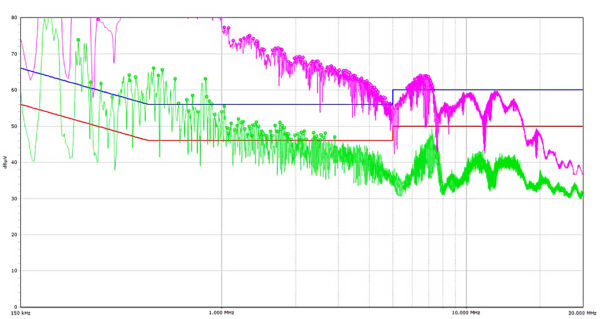
Power supply from the Far East (purchased through an online marketplace):
Permissible levels of conducted and radiated disturbances were exceeded—the pink and green graphs.
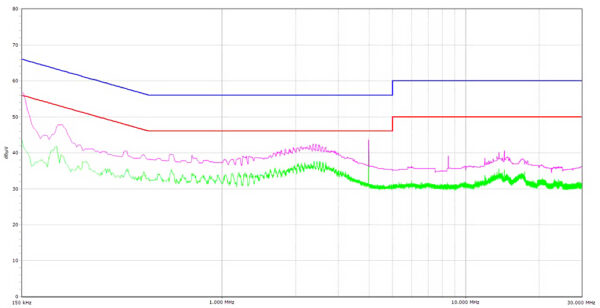
The permissible limits are shown by the red and blue graphs.
Comparable Breve power supply:
Results within the applicable limits.
Breve Laboratory
As a company specializing in switching power supplies, Breve has built a fully equipped EMC testing laboratory based on its own experience in the field. The laboratory is equipped with state-of-the-art measurement equipment.
We perform EMC measurements separately for each production batch for our own purposes, ensuring that our devices comply with all applicable standards. However, our laboratory facilities offer much broader capabilities, which is why we also provide EMC testing services for devices submitted by external companies.
We invite you to take advantage of our range of switching power supplies.
M.Sc. Eng. Krzysztof Majewski