An autotransformer is a device used to change the voltage level. Its fundamental feature is that it provides no galvanic isolation of the secondary side from the primary side. This is undoubtedly a drawback of such a design, however in certain circumstances it brings significant economic savings.
In an autotransformer we are dealing with the following powers:
S = U1I1 ≈ U2I2 – throughput power – the power transferred by way of transformation and conduction.
Sp = S/n – conducted power – the power transferred by way of conduction.
Sw = S – Sp – self power – the inherent power of the core size used.
If, for example, we halve the voltage, i.e. n=2, then the self power of the core size used is half as large, and so in an autotransformer arrangement with a ratio of n=2 we can use a device half the size compared with one meeting the same requirements but carrying out the transformation by means of a transformer.
We obtain the same relationship when we wish to raise the voltage on the secondary side to twice that on the primary side. However, we cannot always take advantage of the economic savings offered by the autotransformer design, for safety reasons arising from the galvanic connection between the transformer secondary side and the mains supply. This applies in particular to step-down autotransformers.
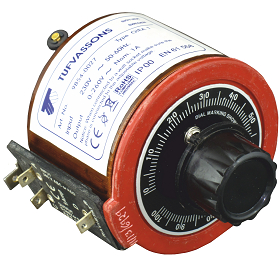
Breve offers three types of variable autotransformers: three-phase units of the VT series, single-phase open units of the OIEA series and single-phase enclosed units of the KIEA series.
Krzysztof Majewski MSc Eng
Sales Department Manager
Breve-Tufvassons