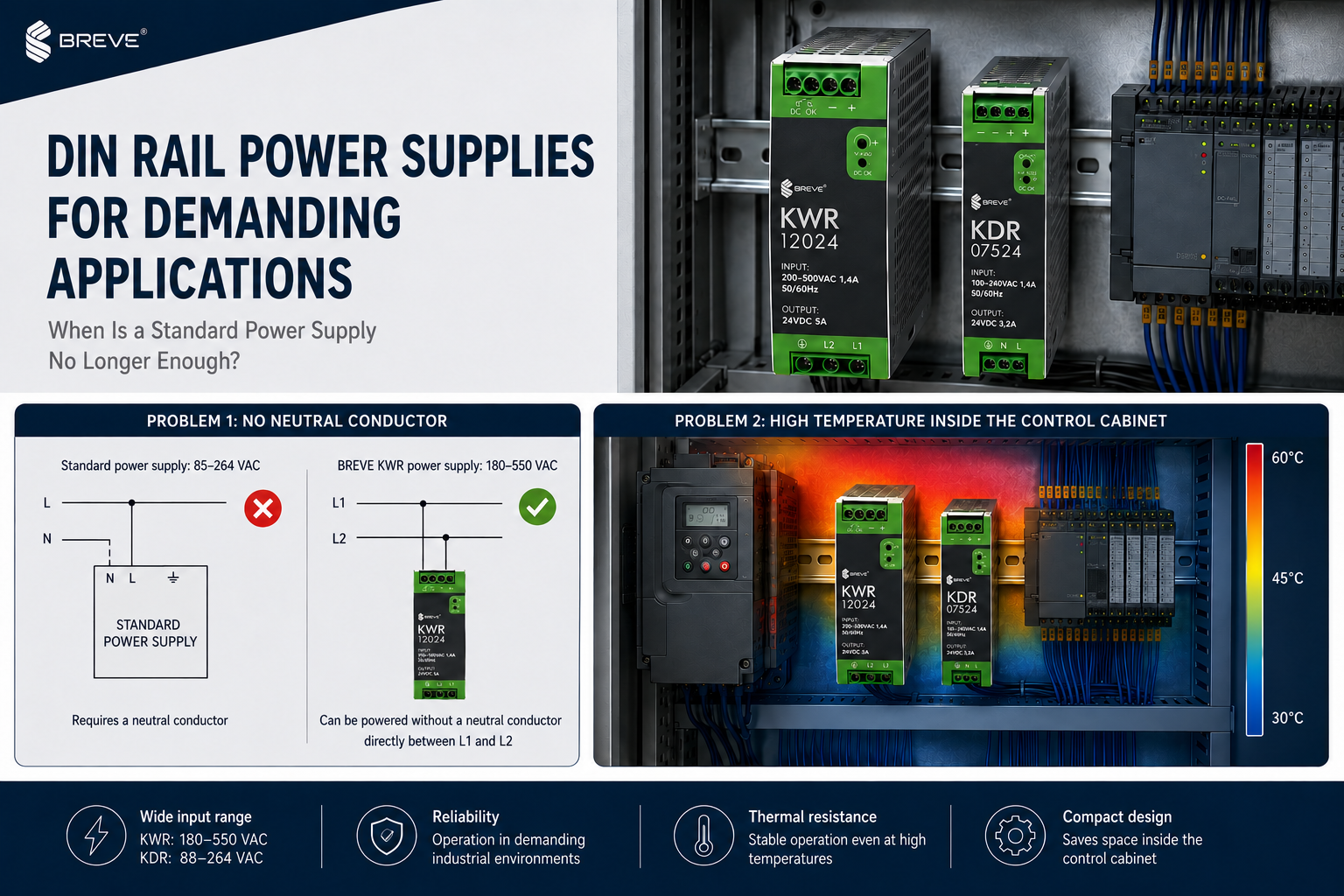
When designing industrial automation systems, selecting a switch-mode power supply often comes down to two parameters: output voltage and required power. In practice, however, it is usually the actual operating conditions, rather than power rating alone, that determine the reliability of the entire system.
Most failures are not caused by a faulty power supply
If a PLC, I/O modules and other loads require 24 VDC and consume approximately 120 W in total, choosing a 150 W or 240 W power supply may seem obvious. This approach works well in many standard applications.
In industrial environments, however, a power supply often operates inside a tightly enclosed control cabinet, at elevated temperatures, surrounded by variable frequency drives, power electronics and other heat-generating devices.
In other applications, only a 400 VAC line-to-line supply may be available, with no neutral conductor. Loads may also draw a current during start-up that is significantly higher than their rated current.
Under these conditions, two power supplies with the same nominal power rating may behave very differently. One may operate reliably for many years, while another may cause random PLC restarts, protection trips or difficult-to-diagnose interruptions in machine operation.
Based on our experience, such problems are often caused not by a defective power supply, but by selecting a unit that is not suitable for the actual operating conditions.
In short: choose the KWR series when 400 VAC line-to-line voltage is available but there is no neutral conductor. Choose the KDR series when the application requires, among other features, short-term overload capability of up to 150% for 3 seconds. In both cases, the final selection should also take into account ambient temperature and the manufacturer’s derating curve. The current product specifications confirm the KWR wide input range and KDR overload capability.
A good power supply is about more than rated power
When talking to machine builders and automation engineers, we are often asked:
Which 24 V power supply will be best for our application?
There is no single universal answer.
A much more important question is:
Under what conditions will the power supply operate?
The operating environment determines which parameters should be considered during the design process. We most often analyse:
- available input voltage,
- type and behaviour of the loads,
- ambient temperature,
- possible temporary overloads,
- diagnostic requirements,
- mounting location inside the control cabinet.
Only after answering these questions can the correct type of power supply be selected.
The BREVE range includes two DIN rail mounted power supply series developed for different application requirements:
KWR – designed for applications requiring a very wide input voltage range.
KDR – designed for applications requiring high overload capability, a wide power range and high efficiency.
Although the two series may look similar, they are intended to solve different engineering problems.
Problem 1 – there is no neutral conductor in the control cabinet
This situation is more common than it might seem.
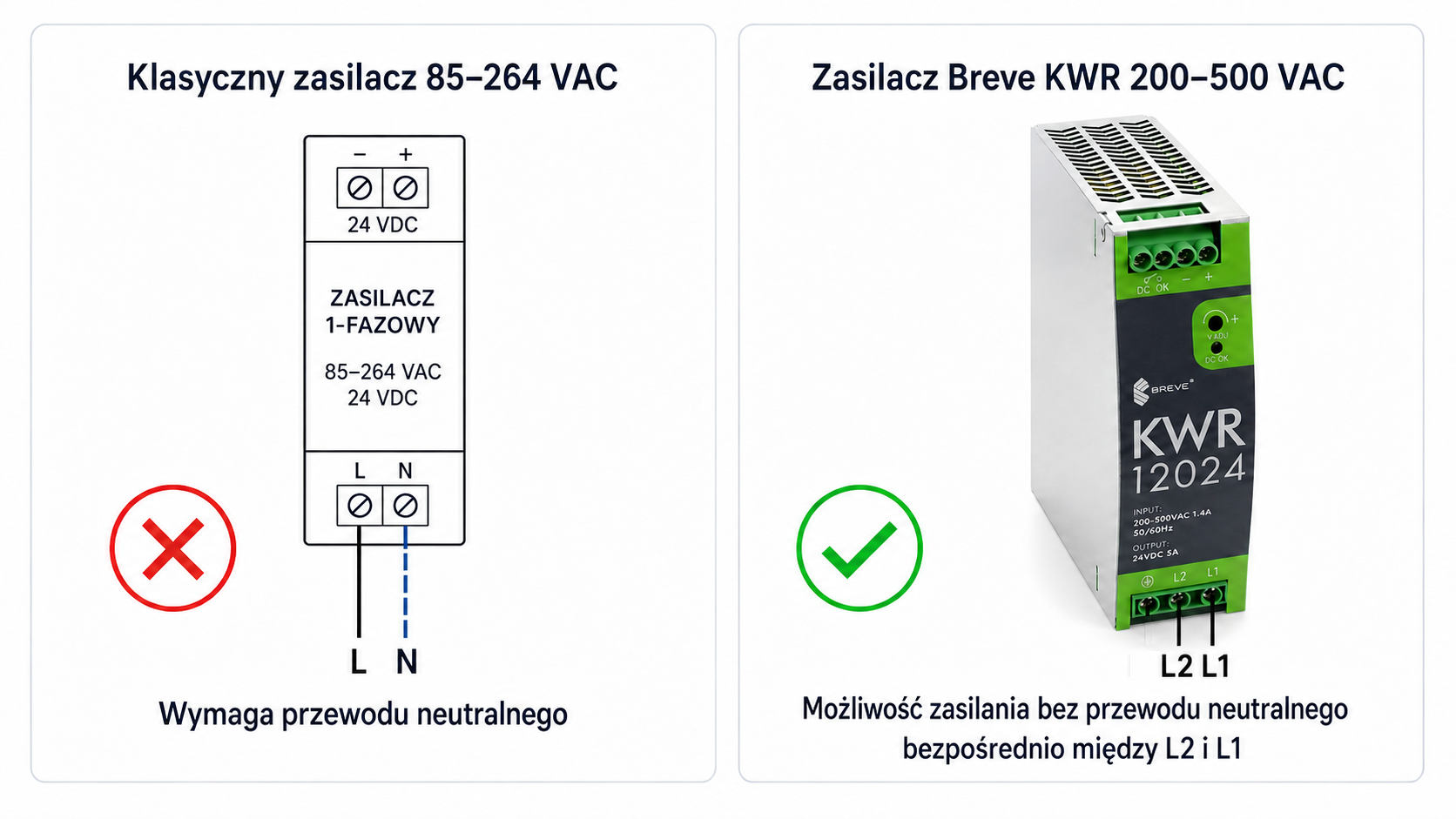
In industrial plants, power substations, wastewater treatment facilities and infrastructure installations, designers may have access only to 400 VAC line-to-line voltage. A neutral conductor is not always available.
In practice, this means that a standard power supply with an input range ending at approximately 264 VAC cannot be connected directly between two phases of the existing 400 V system.
There are three typical ways of solving this problem.
Solution 1 – provide a neutral conductor
From a technical point of view, this is a correct solution.
In practice, however, it may require modification of the electrical installation, additional testing and increased project costs. In existing facilities, installing an additional conductor may also be difficult or impossible.
Solution 2 – use a step-down transformer
Another solution is to use a transformer to reduce the available voltage and supply a conventional 230 VAC power supply.
This works, but the additional transformer:
- takes up valuable space inside the cabinet,
- increases the weight of the switchboard,
- adds another component to the system.
In compact control cabinets, every centimetre of available space may matter.
Solution 3 – use a power supply with a wide input voltage range
In many applications, the simplest solution is to use a power supply designed to operate directly from line-to-line voltage.
The BREVE KWR series was developed for this type of application.
Its current input voltage range is:
180–550 VAC and 254–780 VDC.
This means that the unit can operate directly from two phases of a three-phase 400 VAC system without requiring an additional step-down transformer.
For the designer, this means a simpler electrical design and fewer components inside the control cabinet.
A practical example
Consider the modernisation of a pumping station.
The existing switchboard provides only a 3×400 VAC supply. The new automation system requires:
- a PLC,
- an HMI panel,
- I/O modules,
- an industrial Ethernet switch,
- several relays.
The total power demand is approximately 180 W.
At first glance, almost any 240 W power supply would appear suitable.
During installation, however, it turns out that no neutral conductor is available in the switchboard – only the three phases are present.
Using a conventional power supply would therefore require either rebuilding the installation or adding a transformer.
A KWR power supply can instead be supplied directly from two phases. This simplifies the design, reduces the number of components and can help avoid costly modifications before commissioning.
Problem 2 – the temperature inside the cabinet is much higher than expected
Ambient temperature is one of the parameters most frequently underestimated during power supply selection.
Many technical parameters are specified under laboratory conditions at approximately 25°C.
The interior of an operating industrial control cabinet is very different.
It may contain:
- variable frequency drives,
- servo drives,
- contactors,
- soft starters,
- communication modules,
- PLCs,
- safety relays.
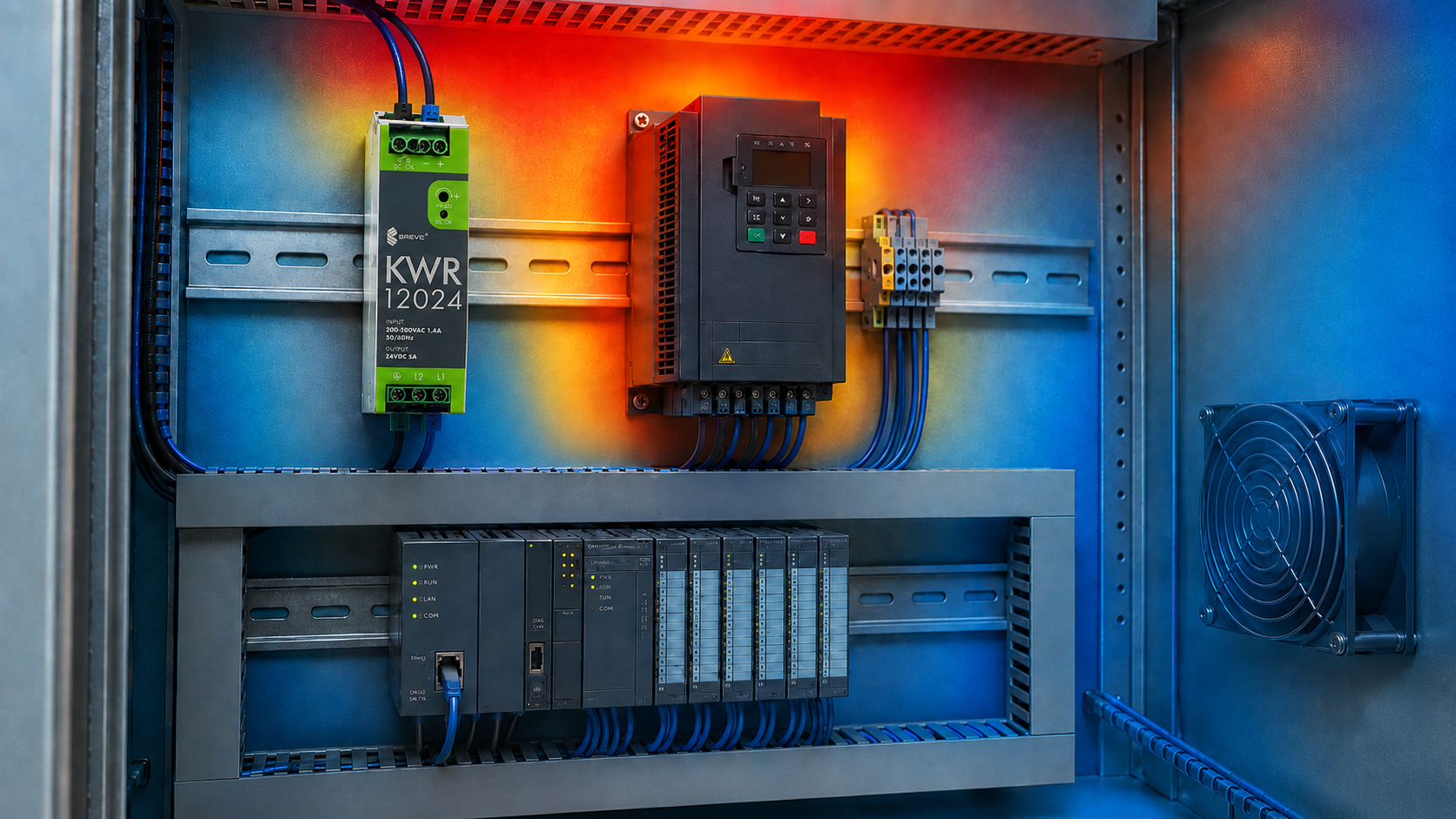
All of these devices generate heat.
After several hours of operation, the air temperature inside the cabinet may be significantly higher than the ambient temperature outside the cabinet.
Temperatures of 45°C or 55°C are not unusual, and some applications may exceed 60°C.
Under these conditions, a power supply behaves differently from the same unit operating under laboratory conditions.
Why do manufacturers publish derating curves?
Datasheets for professional switch-mode power supplies usually include a graph showing the permissible output load as a function of ambient temperature.
Some designers treat this graph as supplementary information.
In reality, it is one of the most important characteristics of a power supply.
Every switch-mode power supply has a limited ability to dissipate heat. If the temperature of its electronic components exceeds their permissible operating range, their service life may decrease significantly.
For this reason, manufacturers specify derating – a gradual reduction of the permissible output power as ambient temperature increases.
The derating curve should therefore always be checked when a power supply is expected to operate at elevated temperature.
Practical advice from a BREVE engineer
Never select a power supply solely on the basis of the combined rated power of the loads.
If the unit will operate at temperatures above approximately 50°C, always check:
- the manufacturer’s derating curve,
- required ventilation,
- recommended mounting clearances.
A few additional centimetres of free space above and below the power supply may sometimes have a greater impact on long-term reliability than simply selecting the next higher nominal power rating.
KWR or KDR – which power supply should you choose?
| Parameter | KWR | KDR |
|---|---|---|
| Main application | Wide input voltage range, line-to-line supply | Demanding loads and temporary overloads |
| Input voltage | 180–550 VAC; 254–780 VDC | 88–264 VAC; 124–370 VDC |
| Power range | 60–480 W | 75–960 W |
| Efficiency | 89–93% | 89–94% |
| Key feature | Operation from 400 VAC without neutral conductor | 150% load for 3 seconds |
| DC-OK signalling | Yes | Yes, except KDR075XX |
| Parallel operation | Depending on model/documentation | KDR960XX in a 3+1 system |
Frequently Asked Questions
Can a 230 V power supply be connected between two phases of a 400 V system?
Not if its maximum permitted input voltage is approximately 264 VAC.
A power supply intended for the appropriate line-to-line voltage must be used. Alternatively, the installation can be modified or an additional transformer can be installed.
When should I choose a KWR power supply?
Choose the KWR series when a wide input voltage range is required – for example, when 400 VAC line-to-line voltage is available but there is no neutral conductor.
The KWR series currently supports an input range of 180–550 VAC and 254–780 VDC.
When should I choose a KDR power supply?
The KDR series is particularly suitable when the application requires a broad power range, high efficiency or temporary overload capability.
KDR power supplies can withstand up to 150% load for 3 seconds.
What does power supply derating mean?
Derating is the reduction of the permissible output power of a power supply as ambient temperature increases.
The manufacturer’s derating curve shows how much load the unit can safely deliver under specified thermal conditions.
Is selecting a power supply with extra power capacity enough?
Not always.
The designer should also consider:
- input voltage,
- ambient temperature,
- load inrush current,
- ventilation,
- mounting clearances,
- diagnostic requirements.
A higher nominal power rating alone does not guarantee reliable operation if the power supply is unsuitable for the actual installation conditions.
Summary
Selecting a DIN rail power supply for a control cabinet should begin with an analysis of the actual operating conditions, not only the required output voltage and nominal power.
Input voltage range, ambient temperature, load characteristics and diagnostic requirements can all have a direct impact on the reliability of the system.
At the design stage, it is worth answering several simple questions:
- Is a neutral conductor available?
- Do the loads draw high current during start-up?
- What temperature can be expected inside the cabinet?
- Should the control system monitor the status of the power supply?
- Is future expansion of the installation planned?
The answers to these questions often lead to a more reliable and cost-effective solution.
The BREVE KWR series is designed for applications requiring a wide input voltage range, including systems where a 400 VAC line-to-line supply is available without a neutral conductor.
The BREVE KDR series is intended for applications requiring high efficiency, a broad power range and increased short-term overload capability.
Instead of selecting a power supply solely by its nominal wattage, designers can therefore choose a solution that matches the real electrical and environmental requirements of the project.
See also
BREVE KWR industrial power supplies
https://www.brevetrafo.com/search/power-supplies-breve/kwr
BREVE KDR industrial power supplies
https://www.brevetrafo.com/search/power-supplies-breve/kdr
Author: Andrzej Szaniewski, Technical Director
Technical review: Marcin Kaczorowski, Power Electronics Design Engineer
Published: 12 March 2026
Last updated: 11 August 2026