Because a transformer generates losses, it is worth introducing the concept of efficiency, which is defined as the ratio of the power delivered to the load to the sum of the power delivered to the load and the copper and iron loss power.
The relationship is as follows:
η = Podd / (Podd + PCu +PFe)
Podd – power delivered to the load
PCu – copper loss power
PFe – iron loss power
The above parameters can be determined with sufficient accuracy from the no-load test and the short-circuit test. It is important to note that a transformer always draws more power from the supply network than it delivers to the load. In some cases it may therefore be necessary to know the efficiency of the transformer, for example in order to correctly select the overload protection on the primary side.
The efficiency of transformers varies according to the rated power of the transformer and lies within the range of approximately 0.3-0.4 for transformers rated at a few VA, up to approximately 0.99 for power transformers in the MVA range.
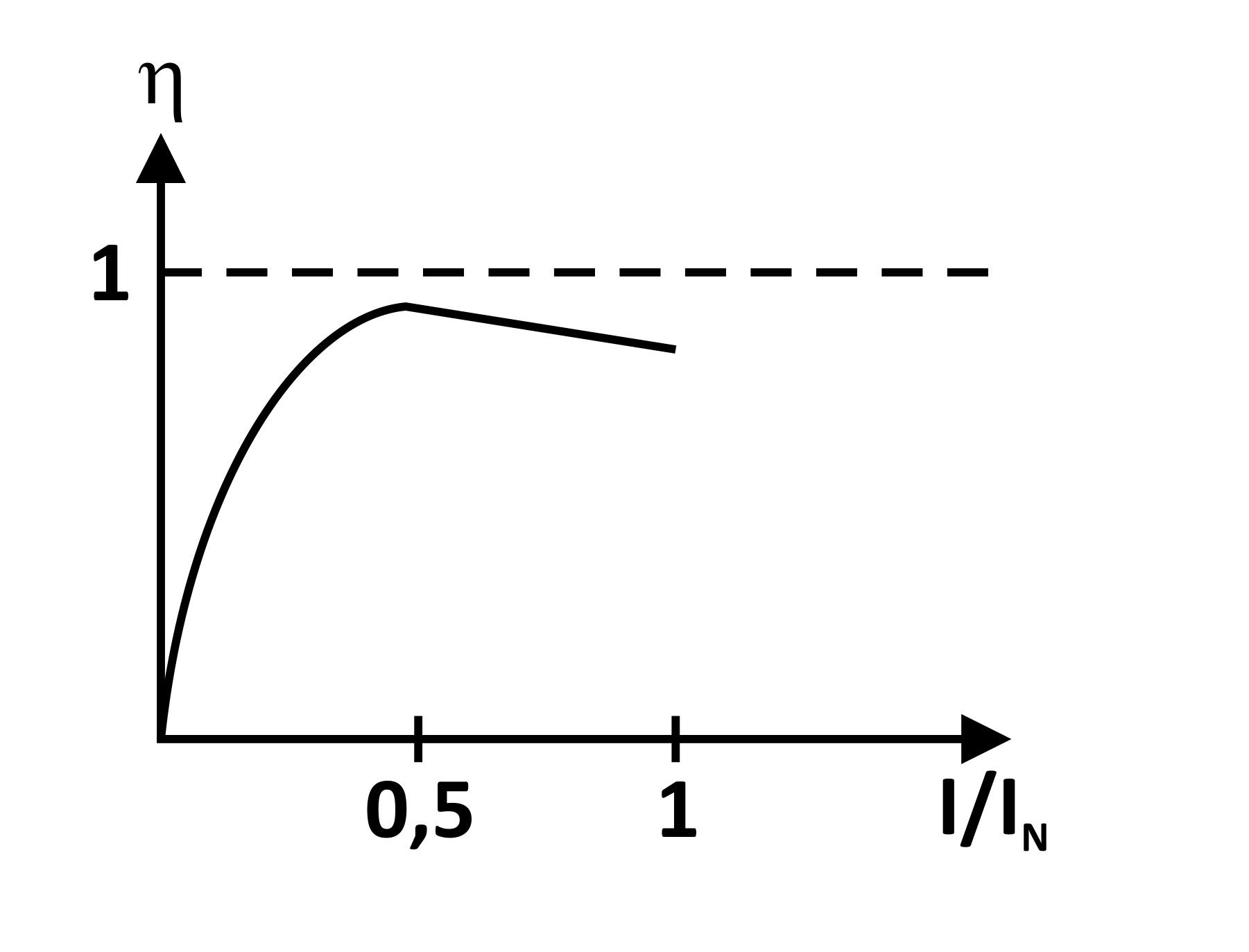
The efficiency of an individual transformer also depends, in a non-linear manner, on the load current of the secondary side. Transformers are designed so that their highest efficiency occurs at approximately half the rated current value.
An approximate illustrative graph of the transformer efficiency relationship is shown in the figure.